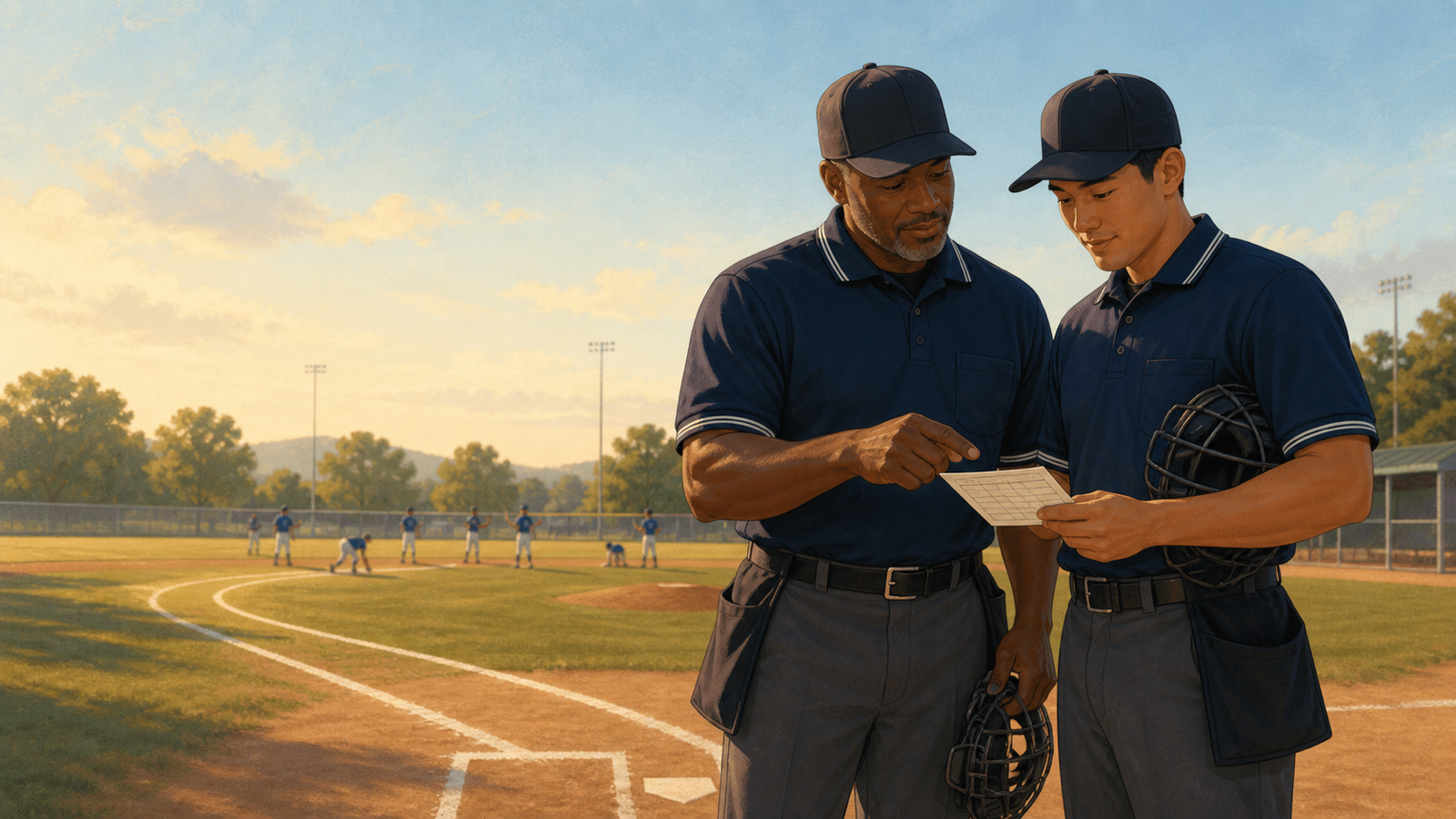
The Little League Baseball World Series puts youth baseball—and volunteer umpiring—on a national stage each August. Local leagues can use that attention for more than a one-week recruiting push. It is a timely moment to show current and prospective officials what development actually looks like.
Short answer
Build an umpire development pipeline by publishing a simple progression from orientation to first assignments, mentored games, independent crews, evaluations, tournament work, and leadership. Give each stage a named owner, objective readiness criteria, appropriate assignments, feedback, and a visible next step. The goal is not to promise a World Series assignment; it is to make local growth understandable and attainable.
Why this is timely now
The 2026 Little League Baseball World Series runs August 19–30, with 38 games scheduled over 11 days. Search interest in the event follows a strong seasonal pattern: a five-year U.S. Google Trends view for “Little League World Series” shows its recurring August concentration. Trends reports relative search interest, not local umpire demand, but the signal identifies the period when families and baseball communities are paying attention.
The officiating connection is direct. Little League says nearly 100 umpires were selected for its seven 2026 World Series events. Its published pathway requires World Series candidates first to work a Region Tournament, followed by an application, review, and final screening. Little League also emphasizes that local and district activity, continued training, feedback, and progression through tournament levels position umpires to succeed.
Your league does not need to copy that selection system. It can borrow the core idea: people are more likely to invest when they can see how today’s local game connects to tomorrow’s responsibility.
1. Draw the pathway on one page
Start with stages that fit your actual program. A useful local model is:
- Explorer: attends an open house or shadows a crew.
- Trainee: completes required screening, rules instruction, and field mechanics training.
- Developing official: works age-appropriate games with an assigned mentor.
- Independent official: accepts suitable games without on-field mentoring.
- Crew leader: supports partners and handles more complex assignments.
- Tournament candidate: meets the applicable league, district, association, or governing-body requirements.
- Mentor or trainer: helps the next group progress.
Keep it honest. Different organizations have different certification, screening, age, and tournament rules. Link to the authority that controls each requirement instead of implying that local completion guarantees advancement.
2. Define readiness with observable criteria
“Ready for bigger games” is too subjective. For each stage, publish a short rubric covering what your league can actually observe:
- Required training and screening are complete.
- Availability and assignment responses are reliable.
- Positioning, mechanics, rules knowledge, and game control meet the level’s standard.
- Communication with partners, coaches, and administrators is professional.
- Feedback is applied across later assignments.
- The official has worked an appropriate range of games before advancing.
Do not make game count the only measure. Ten supported games with useful feedback can reveal more than a crowded schedule with no review. Related: protecting veteran officials from over-assignment.
3. Match assignments to the development stage
A pathway fails when every open game is treated the same. Tag assignments by the experience they require and the learning opportunity they offer. Then pair developing officials with crews and game levels that help them progress without placing them in avoidable failure.
- Reserve lower-complexity games for first independent assignments.
- Place a mentor on the same crew, not merely somewhere at the complex.
- Avoid stacking two unready officials together to fill a gap.
- Explain why a game was assigned and what the official should practice.
- Record late changes so a carefully built crew is not accidentally broken.
For tournament weekends, use a deliberate crew plan rather than rewarding only the people who answer first. See the youth baseball tournament umpire staffing checklist.
4. Make feedback small, prompt, and repeatable
Officials need feedback they can use on the next game. A two-minute debrief can follow a consistent pattern: one strength, one priority adjustment, and one action for the next assignment. Save a brief development note only where your policy permits, distinguish coaching notes from disciplinary records, and limit access appropriately.
Little League’s 2026 local-leadership guidance describes preparation, mentorship, and constant improvement as foundations of strong umpire programs. Its recruitment and retention discussion also highlights positive written or oral evaluation, engagement, training opportunities, transparency, and recognition.
Related: how mentorship retains new officials.
5. Turn tournament viewing into a development event
Use the national event as a teaching prompt, not a comparison exercise. Invite officials to watch one selected game together and focus on a few observable topics: crew communication, positioning, rotations, pace, and recovery after a difficult call. Keep the discussion respectful and tied to your adopted mechanics and rules.
Pair the watch session with a local call to action:
- Publish the next orientation and clinic dates.
- Let current officials choose one development goal.
- Invite former players and coaches to shadow an appropriate local crew.
- Introduce the mentors and training owners by name.
- Show the next three available entry-level assignments.
This converts inspiration into a scheduled next step while interest is high.
6. Recognize progress without promising outcomes
Recognition helps retention when it is specific and fair. Celebrate training completion, first games, first crew-lead assignments, mentoring contributions, and advancement into district or association opportunities. With the official’s permission, share a short profile that explains the work behind the milestone.
Avoid language that guarantees prestigious assignments. Selection outside the league is controlled by the relevant organization. The local promise should be narrower and more valuable: qualified officials will know the criteria, receive useful preparation, and get a fair opportunity to be considered.
7. Run a monthly pipeline review
Once a month, review the pathway as an operations system:
- How many people are at each stage?
- Who has completed requirements but lacks a suitable assignment?
- Who needs a mentor, evaluation, or clearer next step?
- Where are assignments too advanced or too repetitive?
- Which mentors are overloaded?
- Who is approaching tournament or crew-lead readiness?
- Who has gone quiet, and who will check in?
Track movement between stages, not just the total number of names. A large roster can still hide a weak pipeline if new officials never reach independent assignments or experienced officials never become mentors.
Where Umply fits
Umply publicly supports availability-aware assigning, conflict controls, messaging, real-time schedule updates, and live check-ins. Those tools can help administrators coordinate stage-appropriate assignments, keep crew changes visible, and communicate next steps. Training standards, screening, evaluations, and advancement decisions remain the responsibility of the league and its governing organizations.
Related: Umply for league administrators, referee scheduling software, and umpire management.
The practical takeaway
Tournament season can create attention, but a visible pathway creates staying power. Show officials where they begin, what readiness looks like, who will help them, which assignments fit next, and how local service can grow into leadership. That is how a late-August moment becomes a stronger umpire program next spring.
Sources and further reading
- Google Trends: U.S. interest in “Little League World Series,” past five years
- Little League: 2026 Little League Baseball World Series schedule
- Little League: Nearly 100 umpires selected for 2026 World Series events
- Little League: How umpires progress toward Region and World Series tournaments
- Little League: Leading umpires at the local level
- Little League: Recruitment and retention of umpires