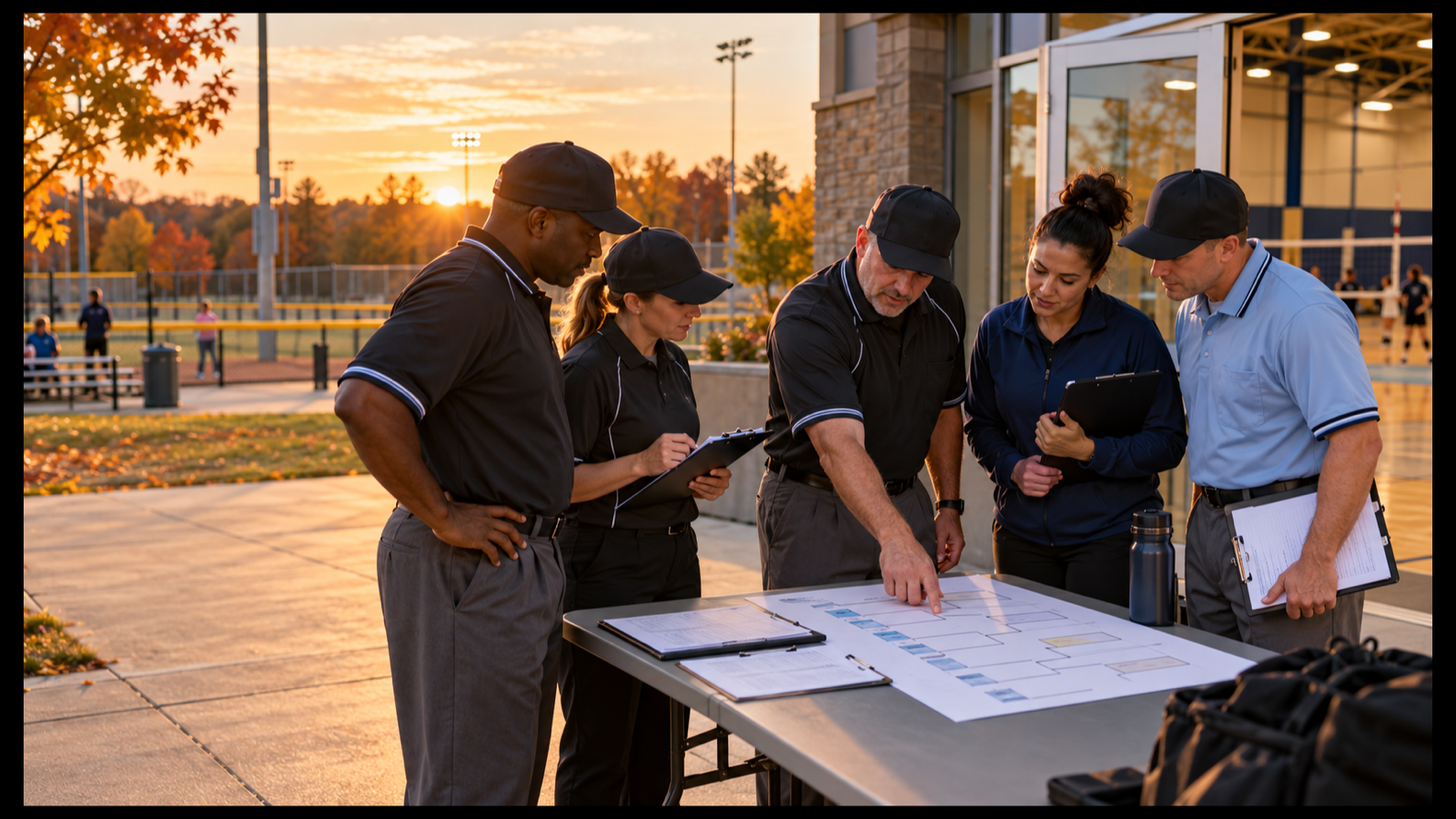
A postseason bracket may not be final until the last regular-season result, but an officials plan cannot wait that long. Elimination games compress the schedule, raise the cost of a late decline, and often require tighter qualification, conflict, travel, and communication checks than an ordinary week.
Short answer
Before brackets lock, build an officials pool for every likely date, venue, and game role. Confirm availability in writing, verify current qualifications, collect team and venue conflicts, set travel limits, identify a primary and backup crew for each bracket slot, and publish one acceptance deadline. When the bracket becomes final, convert the placeholder slots into named assignments, recheck conflicts, send complete game details, and require prompt acceptance. Keep backups warm until the crew checks in.
Why postseason officials planning is timely now
Current search behavior shows administrators, participants, and families turning toward fall playoffs. In the current 90-day U.S. Google Trends comparison, daily relative interest for “volleyball playoffs” rose from 8 on September 28 to 39 on September 29 and 60 on September 30. “Softball playoffs” rose from 4 on September 28 to 14 on September 29 and 23 on September 30. Google Trends is normalized search interest, not a count of games or staffing problems, but the movement is a useful signal that postseason attention is arriving.
The calendar supports that interpretation. The Georgia High School Association's 2026–27 dates list fast-pitch softball playoff series for October 12–15 and October 19–22, with finals October 28–31. The same calendar lists volleyball's first playoff round on October 17, followed by rounds on October 20–21 and October 24 and finals October 27–28. Youth and recreational leagues use different calendars, but the operational lesson travels: a bracket can create several high-priority assignments in a short window.
1. Build the assignment grid before you know the matchups
Create one row for every possible bracket slot, not only the games that already have teams. Include:
- round and game identifier;
- earliest and latest possible date and start time;
- venue or possible venue set;
- number and type of official roles required;
- qualification standard for each role;
- primary crew status and backup crew status;
- acceptance deadline; and
- the person authorized to change an assignment.
Use bracket identifiers such as “Quarterfinal 2” until the participants are known. This separates the staffing problem from the team-name problem and exposes uncovered time blocks early.
2. Ask for postseason availability as a separate commitment
Do not assume regular-season availability carries into the postseason. Work schedules, school activities, family plans, other leagues, and travel tolerance may all change. Send officials the possible windows and ask them to confirm each one as available, unavailable, or conditional.
A conditional response needs a usable condition: “available after 6 p.m.,” “within 25 miles,” or “only if released from another assignment by noon.” Avoid treating “probably” as coverage. Set one response deadline and follow up with nonresponders before provisional crews are built.
3. Verify qualifications and role readiness
Decide the standard before choosing names. Depending on the sport and governing rules, that may include current registration, completed training, age or level eligibility, background requirements, role-specific certification, recent game experience, or a required crew position.
Record the verification source and date. Do not rely on memory or a prior-season roster. If a league operates under a state association, national governing body, or local sanctioning organization, its current postseason rules control. Your internal checklist should support those requirements, not replace them.
4. Collect conflicts before teams populate the bracket
Ask officials to disclose conflicts using the categories your governing rules require. Common examples include a current or recent team affiliation, family connection, coaching relationship, employment, school, club, or another circumstance that could create actual or perceived partiality.
Translate those disclosures into assignment guardrails before team names are known. Then rerun the check as soon as each matchup is final. A blank conflict field is not the same as a verified “none.”
5. Model travel and turnaround as hard constraints
Postseason games can move to higher-seeded sites or neutral venues. Record the official's starting area, maximum travel radius, prior assignment, earliest arrival time, and any back-to-back limitations. Add the arrival buffer required by your league rather than scheduling against first whistle.
Do not solve a gap by creating a fragile doubleheader that depends on perfect traffic, no overtime, and no field delay. If one late finish breaks the second crew, the assignment was never truly covered.
6. Name a backup for every high-consequence slot
A backup is a specific person who has confirmed the date, understands the standby window, and knows when they will be released. A list of phone numbers is not a backup plan.
For each game, record the order of replacement and the decision deadline. If the sport permits a reduced crew only under defined conditions, document who can approve it. Keep the backup informed when the matchup, venue, or start time changes so the standby commitment remains real.
7. Use a two-stage confirmation process
- Provisional confirmation: the official accepts a bracket slot, date window, likely geography, role, and standby expectations.
- Final confirmation: after the matchup locks, the official receives the exact teams, venue, arrival time, partners, compensation, parking or entry instructions, site contact, and conflict recheck.
Give final assignments an explicit acceptance deadline. If the deadline passes, move immediately to the backup sequence instead of letting uncertainty consume the remaining preparation time.
8. Centralize changes and preserve an audit trail
Postseason changes should come from one recognized source. When a game moves, update the master assignment first and then notify the affected crew, backups, site lead, and league administrator. Record who accepted the revision and when.
Avoid running the same assignment through a spreadsheet, private text thread, and separate email list without a clear source of truth. Multiple copies make it difficult to know whether a declined assignment, new venue, or replacement partner reached everyone.
9. Define the game-day escalation clock
Set check-in milestones based on your sport and venue:
- the time when every official must reconfirm or begin travel;
- the time when the site lead flags a missing crew member;
- the time when the assigner contacts the backup;
- the person who decides whether the game can proceed; and
- the communication path for teams and venue staff.
Share the escalation clock before game day. A backup cannot help if the league waits until the scheduled start to make contact.
Postseason officials assignment checklist
- Map every possible bracket slot, venue, role, and date window.
- Collect postseason-specific availability by a firm deadline.
- Verify current qualifications for every proposed role.
- Record team, school, club, family, and venue conflicts.
- Apply realistic travel, arrival, and turnaround limits.
- Name and confirm a backup for every critical assignment.
- Issue provisional assignments before the bracket locks.
- Recheck conflicts when teams and venues become final.
- Send complete details and require final acceptance.
- Run game-day check-ins and release backups only at the defined time.
Where Umply fits
Umply publicly supports official profiles, availability-aware assignments, qualification and conflict guardrails, messaging, live check-ins, and payment visibility. Those capabilities can help a league keep postseason availability, assignment status, communication, and game-day confirmation connected. Umply does not replace governing-body eligibility rules, conflict policies, safeguarding procedures, or the judgment of a qualified assigner.
Related: game-day check-ins that reduce no-shows, referee assigning software versus spreadsheets, protecting veteran officials from over-assignment, and Umply for league administrators.
The practical takeaway
The bracket may be uncertain; the operating plan should not be. Build coverage around slots, constraints, and backups first. Then use the final matchup to complete the conflict check and communication. That sequence gives the league more time to solve real gaps and gives officials a clearer, more professional postseason experience.