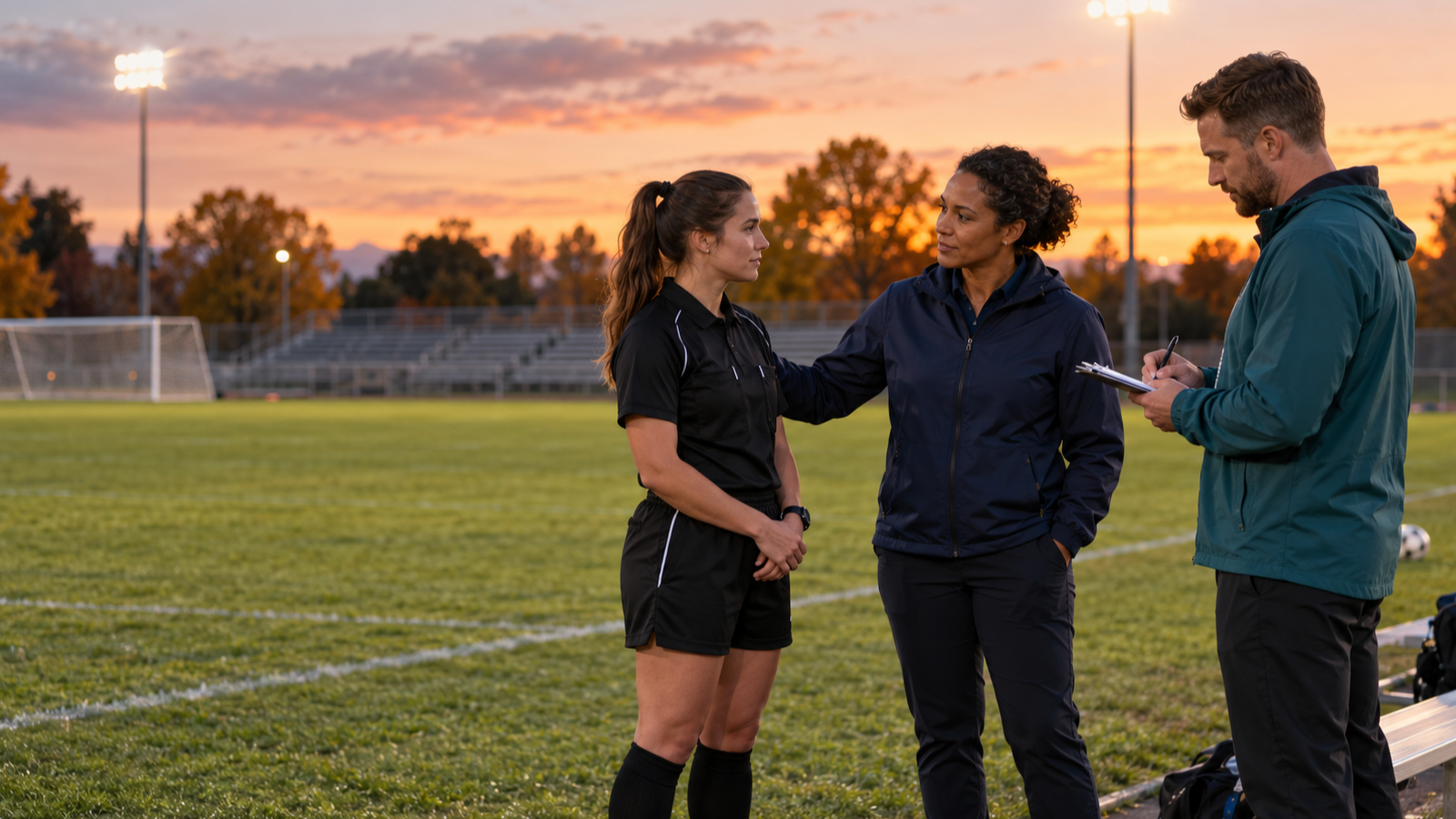
When an official reports abuse, the league's next 24 hours matter. A vague promise to “look into it” can leave the official feeling exposed, while a rushed public judgment can compromise fairness and privacy. League administrators need a response that protects people first, preserves facts, follows policy, and closes the loop.
Short answer
Stop the immediate risk, move the official to a safe place, and contact emergency services when there is a credible threat or injury. Assign one incident lead. Preserve reports, video, messages, and witness names without debating the call that triggered the behavior. Acknowledge the official promptly, explain the review timeline, apply the league's existing conduct and safeguarding rules consistently, and check back before the official's next assignment. Keep game judgment separate from abusive conduct: disagreement with a call never excuses intimidation, threats, discriminatory language, stalking, or physical contact.
Why referee incident response is timely now
October 11 is International Referee Day, and Sport Ireland launched a new Respect for Officials campaign around it. The campaign is backed by University of Ulster research that combined a review of 69 studies with surveys of 715 officials and 478 coaches, athletes, and spectators across 45 sports. The reported drivers included disagreement with decisions, high emotional investment, poor rules knowledge, normalization of abuse, and treating officials as an outside group.
The U.S. calendar is reinforcing the same issue. The Ohio High School Athletic Association designated October 4–10 as Fall Sports Officials Appreciation Week and encouraged administrators to recognize officials before home contests. Appreciation is useful, but the operating test comes when a difficult incident actually occurs.
Search interest remains active as fall seasons continue. In the current 90-day U.S. Google Trends view for “soccer referee”, the term registered daily interest throughout the first 11 days of October, including a relative-interest score of 17 on October 10 and 14 on October 11. Google Trends is normalized search interest, not a measure of abuse or staffing levels. The narrower query “referee abuse” did not return enough U.S. volume for a reliable series, so it should not be presented as a trend.
1. Stabilize the scene before collecting statements
The first job is safety, not investigation. Separate the official from the person involved, provide a private place away from spectators, and identify the site administrator who has authority under league policy. If anyone is injured, threatened, followed, prevented from leaving, or at risk of further contact, use the venue's emergency plan and contact emergency services as appropriate.
Do not ask a young official to confront an adult spectator, negotiate a removal, or walk alone to a vehicle after a serious incident. Follow the league's safeguarding requirements and involve a parent or guardian when policy requires it. If the official wants a support person present, accommodate that where possible without turning the conversation into a group debate.
2. Name one incident lead
One administrator should own the response clock. That person receives reports, preserves evidence, confirms required notifications, and communicates the next step. A single lead reduces contradictory promises and prevents sensitive details from spreading through texts and sideline conversations.
The incident lead should not decide a matter in which they have a direct conflict. If the allegation involves that administrator, their family, or their team, route the review to the alternate named in the league's policy.
3. Record facts without relitigating the call
Use a consistent incident form and collect separate accounts. Record:
- date, time, venue, game, and assignment;
- where the incident occurred and who was present;
- the words or actions reported, using direct language where the witness can recall it;
- what happened immediately before and after;
- actions taken by the official, coach, site lead, security, or emergency services;
- names and contact details for witnesses;
- available video, photos, messages, or platform reports; and
- any injury, safety concern, or requested support.
Ask open questions such as “What did you see or hear?” Avoid questions that suggest the desired answer. Preserve original files and timestamps when practical. Do not ask witnesses to coordinate their accounts.
The correctness of a judgment call is a separate review. The conduct question is whether behavior violated the league's policy. Combining the two implies that abuse might be justified if the call was wrong.
4. Send a same-day acknowledgment
The official should not have to wonder whether the report disappeared. Send a brief acknowledgment that:
- confirms the report was received;
- names the incident lead;
- states the expected review timeline;
- explains how to share additional evidence;
- identifies the contact for an urgent safety concern; and
- asks whether the next assignment needs to be adjusted while the review is pending.
Do not promise a particular sanction before the review. Do promise a process and meet its deadlines.
5. Apply the correct policy and escalation path
Classify the report under the rules that actually govern the league: spectator conduct, coach discipline, player conduct, discrimination or harassment, safeguarding, venue security, or criminal behavior. Notify a governing body, insurer, facility, school, or law enforcement when the applicable policy or law requires it.
Interim measures should protect the process without presuming the outcome. Depending on policy, that may mean restricting direct contact, changing a site assignment, assigning an administrator to the next game, or temporarily limiting attendance. Document who authorized the measure and when it expires.
Consistency matters. Use the same decision factors for a well-known coach, a first-time spectator, and a board member. Record the policy section, verified facts, decision, and appeal route rather than relying on reputation or pressure.
6. Communicate on a need-to-know basis
Tell the affected parties what they need to know to follow the process. Avoid naming an official, a minor, or an accused person in a public statement unless the league has a clear legal and policy basis. Do not post witness accounts or incident video to generate public support.
If families need a message, keep it operational: restate the conduct standard, identify who manages sidelines, explain how to report concerns, and make clear that game officials should not be approached after a contest. Privacy is not silence; it is disciplined communication.
7. Protect the next assignment
Retention risk often appears after the report is filed. Ask the official what would make the next assignment workable. Options may include a different venue, an experienced partner, a named site contact, an escort to parking, a short break, or removal from the affected team's games while the matter is reviewed.
Do not punish the official for reporting by quietly reducing desirable assignments. If a schedule change is requested, record it as a safety or support accommodation rather than a performance issue. For a minor official, use the league's safeguarding process and communicate with the parent or guardian as required.
8. Close the loop and learn from the pattern
At the end of the review, tell the official that it is complete and share whatever outcome the league can disclose under its policy. Explain any operational changes, such as a site monitor, coach briefing, spectator boundary, or reporting reminder. Then check in again before or after the official's next game.
Track de-identified patterns by team, venue, time, and incident type. A cluster may reveal that a particular field lacks a visible site lead, that post-game parking creates unsafe contact, or that coaches do not understand their sideline responsibilities. Use the pattern to change the environment, not to create a rumor file.
A 24-hour referee incident response checklist
- Stop the immediate risk and move the official to a safe place.
- Use emergency and safeguarding procedures when required.
- Name one incident lead and check for conflicts.
- Collect separate factual accounts and preserve original evidence.
- Keep the disputed call separate from the conduct review.
- Acknowledge the report and provide a timeline the same day.
- Apply the correct conduct, discipline, and notification rules.
- Limit communication to people who need it.
- Adjust the next assignment when support or safety requires it.
- Close the loop, document the decision, and review patterns.
Where Umply fits
Umply publicly supports official profiles, assignments, messaging, check-ins, and league communication. Those capabilities can help administrators identify the affected assignment, reach the right people, and coordinate a supported return to games. Umply does not replace emergency services, safeguarding procedures, governing-body reporting, legal advice, or a fair disciplinary process.
Related: why parent behavior is a referee retention issue, how game-day check-ins strengthen coverage, a retention check-in for first-year officials, and Umply for league administrators.
The practical takeaway
A league cannot prevent every heated moment, but it can control what happens next. Protect the official, preserve the facts, follow a known policy, communicate with discipline, and support the next assignment. A credible 24-hour response tells officials that reporting is worthwhile and tells the community that respect is an operating standard, not a slogan.