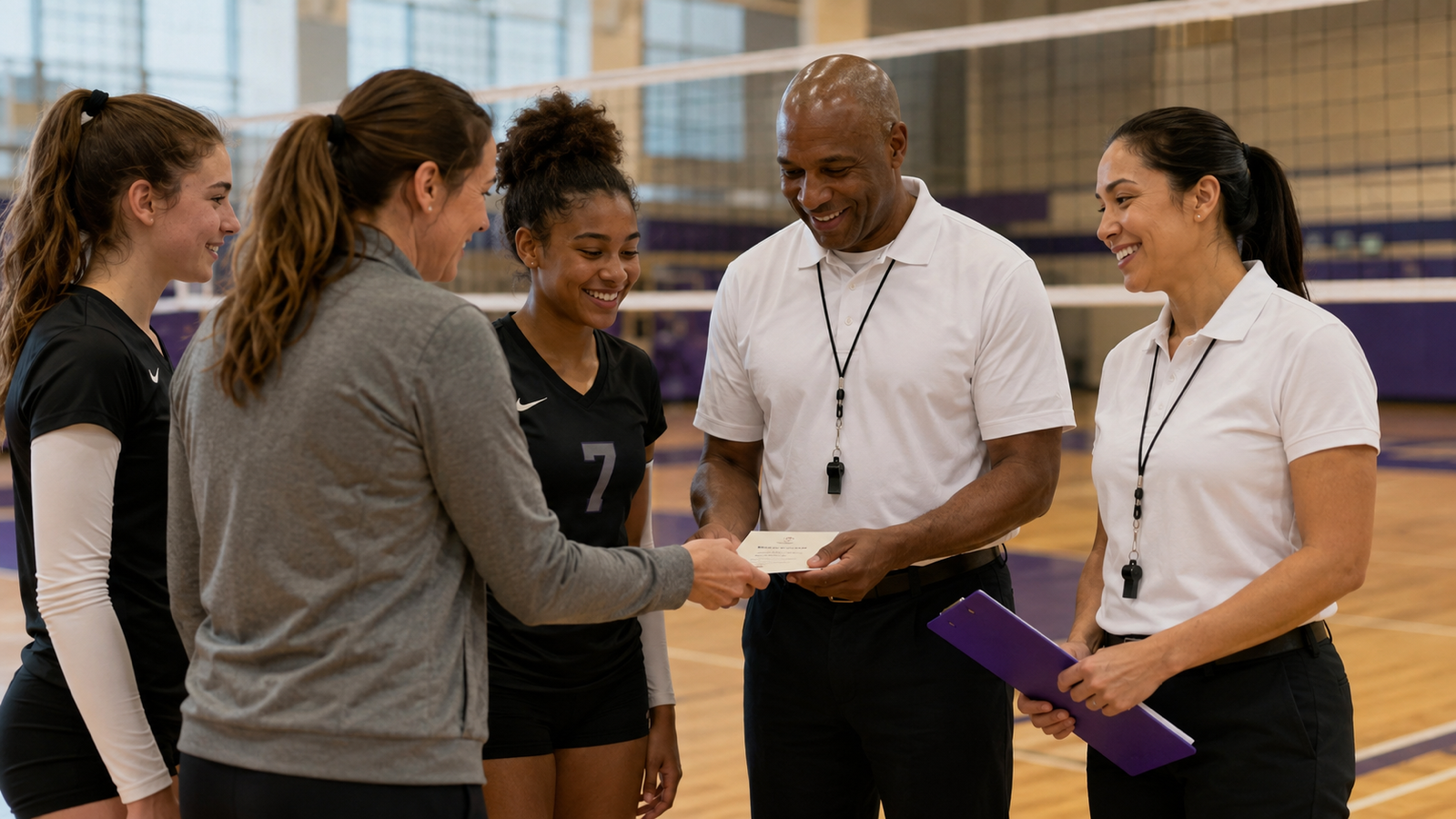
A thank-you card is meaningful. A league that pairs appreciation with better working conditions can make it last. With the 2026 fall Volleyball Officials Appreciation Week approaching, youth volleyball administrators have a natural deadline for listening to officials, improving match-day support, and turning visible gratitude into a repeatable retention process.
Short answer
Choose one match between September 25 and October 3, coordinate a simple pre-match recognition with both teams, and protect officials' privacy. Then use the week to run a short anonymous pulse survey, audit recent assignment changes and late starts, assign an administrator to handle spectator behavior, and close the loop on two or three fixes within 30 days. Appreciation helps retention when officials can see that the league listened and changed something concrete.
Why volleyball official retention is timely now
Search demand is moving with the fall season. In a 12-month U.S. Google Trends view for “volleyball referee”, the week beginning August 30 reached a relative-interest score of 77, the highest weekly level since late July and above each of the prior six full weeks. Google Trends is normalized search interest, not a count of officials, but it shows that people are actively seeking volleyball-officiating information as fall play gets underway.
The calendar adds a specific opportunity. The American Volleyball Coaches Association has scheduled its fall Volleyball Officials Appreciation Week for September 25 through October 3, 2026. AVCA says the campaign began in response to the national shortage of high school volleyball officials and reports that the 2025 fall event included more than 815 teams across 46 states, Washington, D.C., Canada, and Puerto Rico.
The broader pipeline still deserves attention. In July 2026, the National Federation of State High School Associations reported that officials registrations continue to rise nationwide, while warning that recovery remains uneven by state and sport. The practical message for a local league is simple: improvement at the national level does not guarantee enough qualified officials for your dates, locations, and competition levels.
1. Define the outcome before planning the celebration
Decide what your league wants to learn or improve. Useful goals include increasing the share of officials who say they intend to return, reducing late assignment changes, improving site-manager response to spectator problems, or giving newer officials more appropriately matched assignments.
Do not use retention as a vague slogan. Pick one experience measure and one operating measure. For example:
- Experience measure: “I feel supported by this league when a match becomes difficult.”
- Operating measure: percentage of assignments changed within 48 hours of first serve.
Take a baseline before Appreciation Week and review it again 30 days later. A small league does not need a complex dashboard; it needs consistent definitions and an owner.
2. Follow the event guidance and protect officials
AVCA recommends choosing a match during the event window, recognizing officials before the coin toss with both teams, taking a group photo, sharing the event with the campaign hashtag, and submitting the event for the national participant list. The organization also cautions teams not to publish officials' names in programs, banners, flyers, or social posts.
Translate that into a simple league checklist:
- Confirm the selected match and both teams' participation.
- Ask the assigned officials whether they are comfortable joining a photo.
- Prepare a short public-address thank-you and a modest token.
- Keep names and contact details out of public materials.
- Designate one person to capture and publish approved content.
- Thank every official working that week, not only the crew at the showcase match.
3. Ask three questions that can lead to action
Send a three-minute pulse survey to active officials. Keep it anonymous when your pool is large enough, and do not collect demographic or disciplinary details you do not need.
- How likely are you to officiate for this league next season?
- What part of working our matches creates the most avoidable friction?
- What is one change we could make in the next 30 days?
Add an optional follow-up field for anyone willing to discuss the answer. Separate feedback about safety or misconduct and route it through the league's established reporting process rather than leaving it in a survey inbox.
4. Audit the moments officials actually feel
Appreciation is undermined when the weekly workflow is chaotic. Review the last four weeks of matches for:
- assignments accepted and later replaced;
- changes made less than 48 hours before first serve;
- incorrect addresses, start times, age groups, or match formats;
- officials assigned beyond their recorded qualification or desired workload;
- late gym access, missing site contacts, or unavailable equipment;
- unresolved spectator or coach behavior reports; and
- payments or reimbursements that missed the league's stated timeline.
Look for patterns, not blame. If one gym produces most late starts, the fix may be a facility handoff. If newer officials decline high-level matches after one difficult night, assignment matching and mentorship deserve attention.
5. Prepare everyone for the current volleyball season
Respect includes making sure the match environment supports clear, current officiating. The 2026–27 NFHS volleyball rules changes include changes involving libero uniform bottoms, penalties for non-playing teammates entering the court during play, screening during service, and a prohibition on players wearing audio or video devices during a match. NFHS also lists host management best practices among this season's points of emphasis.
League administrators should confirm which rules code governs their competition and distribute the authoritative changes to coaches, site managers, and officials. Do not ask officials to teach every new rule during a tense match. A short preseason briefing and a clear game-management contact reduce preventable conflict.
6. Make two visible fixes within 30 days
Publish a short “what we heard and what we changed” note to officials. Choose fixes the league can own, such as:
- locking schedules 72 hours earlier;
- adding a named site contact to every assignment;
- requiring pre-match reminders about spectator conduct;
- pairing first-year officials with experienced partners;
- adding travel limits and maximum weekly match counts; or
- publishing the payment calendar and an escalation contact.
State what will change, who owns it, and when officials should expect to notice it. If a popular request is not feasible, explain why and identify the smaller improvement you can make.
7. Continue recognition after the campaign ends
Create a lightweight monthly rhythm: one official check-in, one operating-metric review, and one coach or parent reminder. Recognition should not depend on public photos. A private note after a well-managed match, a development opportunity, or a schedule that respects stated availability can carry more weight than a one-day ceremony.
Related: how mentorship helps retain new officials, how parent behavior affects referee retention, and how to protect veteran officials from over-assignment.
A practical 30-day plan
- Week 1: choose the recognition match, confirm privacy preferences, and collect baseline feedback.
- Week 2: review scheduling, site-management, behavior, and payment friction; select two fixes.
- September 25–October 3: run the appreciation event, thank the full official pool, and communicate the changes.
- Within 30 days: confirm implementation, repeat the two measures, and tell officials what improved or still needs work.
Where Umply fits
Umply publicly supports role-based official management, availability-aware assignments, conflict guardrails, self-claiming, live check-ins, and payment visibility. Those tools can help a league make the operational changes behind an appreciation campaign easier to repeat. Umply does not replace governing-body rules, qualification decisions, conduct policies, or direct communication with officials.
Related: Umply for league administrators, referee scheduling software, and Umply features.
The practical takeaway
Use Volleyball Officials Appreciation Week as the start of a listening-and-improvement cycle, not the finish line. Recognize officials visibly, protect their privacy, measure the friction in their weekly experience, and make a few changes they can feel before the season ends. That is how a thank-you becomes a retention plan.