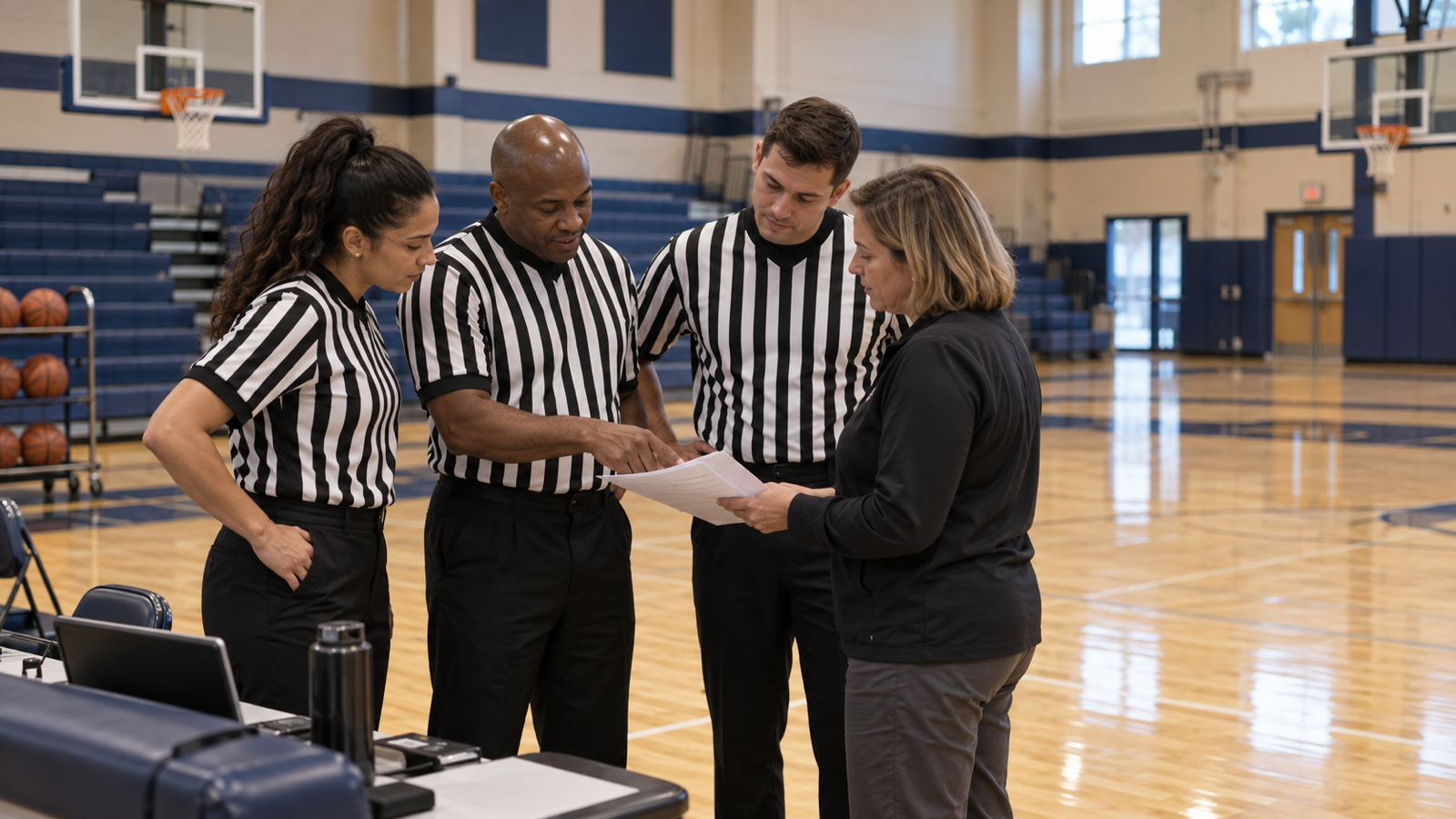
A name on an officials roster is not the same as a game-ready referee. Before a youth basketball league locks its winter schedule, administrators should confirm who is qualified, available, prepared for current rules, and realistically able to cover each gym and time window. A short readiness check now can expose fragile coverage while there is still time to train, recruit, pair, or reschedule.
Short answer
Run the readiness check four to six weeks before opening day. For every official, verify current registration or certification under the league's governing rules, completed training, desired age groups and crew roles, recurring availability, travel limits, and communication details. Then test the draft schedule by gym, time block, and required crew—not by total roster size. Mark every game confirmed, fillable, or at risk, assign an owner to each gap, and repeat the check before assignments become final.
Why basketball referee readiness is timely now
Search behavior is beginning to turn toward basketball officiating. In the current 12-month U.S. Google Trends view for “basketball referee”, relative interest rose from 16 for the week beginning September 6 to 21 for the week beginning September 13. “Basketball referee course” also appears as a rising related query at +130%. Google Trends reports normalized search interest, not a count of officials, but these signals show people are seeking officiating and training information as fall preparation begins.
The operating calendar is approaching quickly in several markets. The Georgia High School Association lists October 19 as the first basketball practice date and November 6 as the first contest date for 2026–27. The Ohio High School Athletic Association lists November 23 and November 30 as the girls' and boys' season start dates. Youth leagues set their own calendars, but those dates illustrate the near-term demand on a shared officiating pool.
Preparation is more than filling slots. The 2026–27 NFHS basketball rules add guidance on end-of-period clock timing and timing-error corrections, while the current points of emphasis include timing corrections, bench decorum, physical play, traveling, and player equipment. Each league should use the rules code and qualification process that actually governs its competition.
1. Define “ready” for your league
Create one readiness standard before contacting officials. At minimum, “ready” should mean the person has:
- met the league's current registration, background-check, age, and training requirements;
- confirmed the competition levels and crew positions they can work;
- reviewed the current rules and local modifications that apply;
- provided useful availability and travel limits;
- confirmed payment and tax-information requirements, if applicable; and
- received the league's conduct, incident-reporting, and game-day communication process.
Do not treat an expired credential, unfinished course, or missing availability response as a minor note. It is an unresolved dependency with an owner and a deadline.
2. Audit the roster one person at a time
Use a consistent status for each official:
- Ready: all league requirements are verified and availability is current.
- Ready with limits: qualified for defined levels, roles, dates, or locations.
- Pending: one or more required steps has a known completion date.
- Inactive: not available for the upcoming season.
- Unknown: the league has not received a current response.
Only the first two groups belong in dependable scheduling capacity. Pending officials can become ready; unknown officials are a follow-up list, not coverage. Send each person a concise summary of what the league has on file and ask them to correct it by a specific date.
3. Verify rules preparation without inventing your own exam
Point officials to the authoritative materials for the competition. For leagues using NFHS rules, this season's changes include a minimum three-tenths of a second for certain late-period restarts and permission to use an official's visible or silent count as definite knowledge when correcting some timing errors. The NFHS comments on the rules also emphasize clear communication between officials and timer personnel.
A practical preseason session can cover:
- the governing code and any league-specific modifications;
- court, ball, period-length, and clock differences by age group;
- crew mechanics and who handles the pregame conference;
- timing-error and scorer's-table communication;
- bench decorum and spectator escalation; and
- injury, ejection, and incident-reporting procedures.
Track completion of required education, but leave licensing and rules interpretation to the appropriate governing body.
4. Convert availability into usable windows
“Usually free on weekends” is difficult to schedule. Ask officials for recurring windows, blackout dates, earliest arrival times, maximum travel distance, preferred competition levels, maximum games per day, and willingness to serve as a reserve.
Then map that information against the actual draft schedule. Group games by:
- day and start-time band;
- gym or venue cluster;
- age group and competition level;
- required number of officials;
- special crew-role or experience needs; and
- turnaround and travel time between assignments.
This exposes the difference between having 40 names and having six qualified people available across three gyms on Saturday morning.
5. Stress-test the schedule before it locks
For each game, assign one of three preseason statuses:
- Confirmed capacity: enough ready officials are available for the required crew.
- Fillable: coverage is plausible, but depends on pending steps, a reserve, or a specific pairing.
- At risk: qualified availability is insufficient or relies on unrealistic travel or workload.
Run three simple failure tests: one official cancels, an earlier game runs long, and a gym changes time. If any scenario uncovers several games, adjust the schedule or reserve plan before publication. Related: protecting veteran officials from over-assignment.
6. Match developing officials with the right support
A readiness check should create appropriate opportunities, not merely screen people out. Identify newer officials who can work defined age groups with an experienced partner, and record the pairing requirement so it survives later schedule changes. Give mentors a narrow assignment: a pregame check-in, one or two observation points, and a short postgame debrief.
Avoid making a first assignment the league's hardest rivalry, longest trip, or least-supported gym. See how mentorship can improve new-official retention and how to support teen officials.
7. Prepare the gym and scorer's table, not only the crew
Current NFHS timing guidance underscores that game administration is shared. Before opening day, verify that each site has a working clock, trained timer and scorer, correct game details, a named site contact, and a clear process for reporting malfunctions or conduct issues. Tell officials whom to contact if the gym is locked, the prior game runs late, or table personnel are missing.
Include exact entrance and parking instructions. In a multi-gym complex, a street address alone may not be enough for an on-time pregame.
8. Set deadlines and one source of truth
Give every pending item an owner and date. A useful sequence is:
- Six weeks out: request credentials, training status, limits, and availability.
- Four weeks out: publish the first capacity map and resolve high-risk time blocks.
- Three weeks out: complete rules and game-administration preparation.
- Two weeks out: verify pairings, reserves, site contacts, and payment setup.
- One week out: reconfirm assignments and distribute final game-day instructions.
Keep the authoritative schedule and official status in one system. Parallel spreadsheets, texts, and email chains make it too easy for a qualification update or time change to reach only part of the crew.
Youth basketball referee readiness checklist
- Define the league's ready, limited, pending, inactive, and unknown statuses.
- Verify required registration, screening, and education.
- Record approved age groups, competition levels, and crew roles.
- Collect recurring availability, blackout dates, travel limits, and workload preferences.
- Review current rules changes and local modifications.
- Map ready capacity by gym and time block.
- Flag pairings, single points of failure, and unrealistic travel.
- Name reserves and escalation owners.
- Confirm scorer's-table and site-management readiness.
- Recheck the roster before assignments become final.
Where Umply fits
Umply publicly supports official profiles, availability-aware assignments, qualification and conflict guardrails, messaging, self-claiming, live check-ins, and payment visibility. Those capabilities can help a league keep readiness information connected to assignments instead of spreading it across separate lists. Umply does not replace governing-body registration, background checks, rules education, or the league's judgment about who is qualified for a game.
Related: Umply for league administrators, referee scheduling software, and Umply features.
The practical takeaway
Do not wait for the first assignment decline to learn that the roster was only theoretical. Verify each official's readiness, translate availability into real game windows, test the schedule against predictable disruptions, and fix the fragile blocks before publication. A preseason readiness check turns a list of names into a coverage plan.