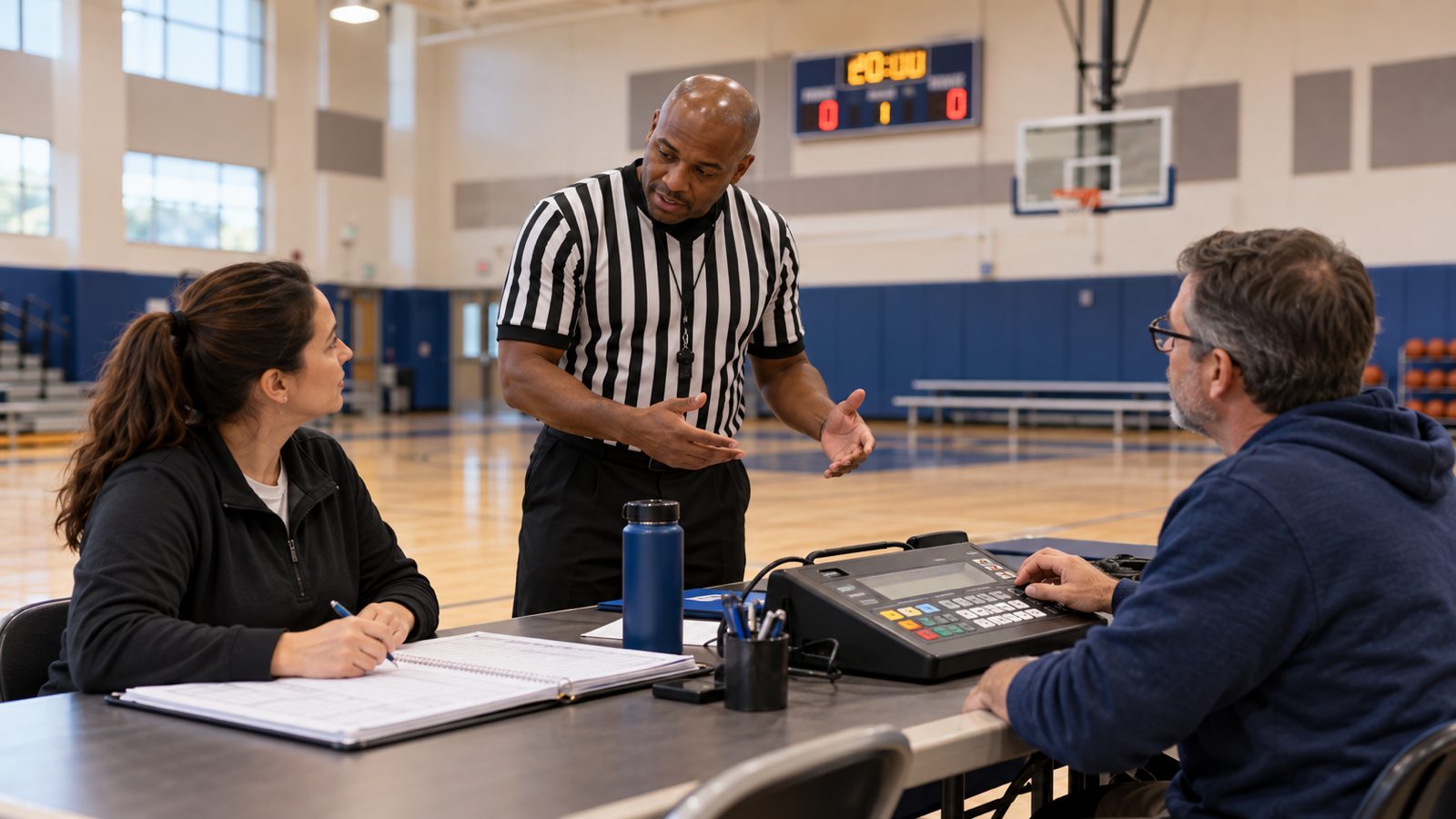
A trained officiating crew can still have a rough opening night when the scorer's table is unprepared. A missing roster, unfamiliar clock console, unclear possession-arrow procedure, or silent timing mistake forces referees to stop the game and solve an operations problem in public.
Short answer
Before the first youth basketball game, assign one trained timer and one trained scorekeeper, give each person a written role, test the clock and horn with the exact equipment they will use, prepare team rosters and game rules, and hold a two-minute pregame conference with the referee crew. Define who records fouls and timeouts, who operates the possession arrow, how the table alerts officials, and what happens when the clock, book, or staffing plan fails. Run the same check before every opening-week game.
Why scorer's-table readiness is timely now
U.S. search interest is moving into basketball season. In the current 90-day Google Trends comparison, relative interest for “youth basketball” reached 100 on October 13 and remained at 89 on October 18, compared with 62 on July 19. Google Trends values are normalized search interest, not participation or staffing counts, but the rise is a useful signal that families and programs are actively turning toward the winter season.
The rules environment makes table preparation especially relevant. The NFHS 2026–27 basketball rules changes add guidance for timing corrections, including a minimum three-tenths of a second in certain late-period throw-in situations and use of an official's count as definite knowledge when correcting some clock errors. The 2026–27 points of emphasis say strong communication between officials and scorer's-table personnel is essential when timing mistakes or equipment issues occur.
Youth leagues may use modified rules or a different governing code, so administrators should teach the rules that actually govern their games. The operational principle is universal: the table needs defined people, working equipment, current rules, and a clear communication path before tipoff.
1. Staff two distinct roles
Whenever possible, use one timer and one official scorekeeper. The timer watches live play and controls the game clock, period display, horn, and any other timing device assigned by league rules. The scorekeeper records starters, points, fouls, timeouts, and other book information required by the competition.
Combining both roles may be unavoidable in a small program, but it increases cognitive load and removes a cross-check. If one person must do both jobs, reduce other duties, place a trained backup nearby, and give the referee crew advance notice.
2. Train on the actual console and scorebook
A generic video cannot teach the quirks of a particular gym. Schedule a short hands-on session with the same controller, horn, scoreboard, scorebook, and possession indicator used on game day. The timer should practice:
- setting the correct period length and warmup time;
- starting and stopping the clock on a referee's signal;
- adding or removing time without clearing the score;
- correcting the score and team-foul display;
- operating the horn without accidentally changing the clock; and
- recovering after a power interruption or controller reset.
The scorekeeper should practice entering a roster, tracking individual and team fouls, recording timeouts, checking the running score against the display, and marking the information the referee will inspect. Use a mock quarter with deliberate mistakes so volunteers learn the correction process before spectators are watching.
3. Create one table packet for every game
Prepare a small digital or printed packet that includes the game identifier, teams, age group, venue, start time, period length, timeout rules, overtime rules, clock modifications, roster source, emergency contact, site lead, and referee crew. Add the league's procedure for a missing player, late roster, equipment failure, or disputed book entry.
Do not rely on a volunteer to remember that one division uses a running clock while another stops on every whistle. Put the differences on the first page and label the packet with the exact division.
4. Run a two-minute pregame conference
Before each opening-week game, the referee crew and table staff should confirm:
- who is the official scorekeeper and who is the timer;
- which rules code and local modifications apply;
- the period length, halftime, overtime, and any running-clock rule;
- how substitutes report and where they wait;
- who handles the possession arrow and when it changes;
- how the table will alert officials to a book, clock, foul, or timeout issue; and
- the fallback if the scoreboard or horn stops working.
This is not a rules clinic. It is a final alignment check that prevents three people from discovering different assumptions after the game starts.
5. Give the table a safe way to report errors
Table staff should not shout over play, argue with a coach, or make an independent rules correction. Teach the approved signal or horn procedure for bringing an issue to the officials at the next legal opportunity. The scorekeeper should state what the record shows; the timer should state what they observed; the referee then applies the governing rule.
Write down the time, period, score, possession, and reason for any material correction. A short incident note helps the league review repeated equipment or training problems without reconstructing the event from memory.
6. Separate table operations from spectator pressure
Place the table where staff can see the court and communicate with officials without being surrounded by spectators. Identify one site administrator—not the timer or scorekeeper—to handle coach, parent, facility, or conduct issues. Table volunteers should be able to focus on the game record and clock.
The current NFHS points of emphasis also address bench decorum and professional conduct. Even when a youth league is not governed by NFHS rules, the management lesson holds: coaches communicate through the channels defined by the league, while table staff remain neutral and focused on their assigned duties.
7. Build a backup plan that is specific
“Find another parent” is not a backup plan. Name at least one trained alternate for each opening-week shift, store a short console guide at the table, keep blank score sheets available, and identify the facility contact who can access replacement equipment.
If the clock fails, the referee crew needs to know whether a visible manual timer, alternate scoreboard, or other league-approved procedure is available. If a scorekeeper does not arrive, the site lead—not the officials—should activate the staffing backup.
Opening-night scorer's-table checklist
- Assign a trained timer, scorekeeper, and named backup.
- Confirm the correct game, division, rules, and local modifications.
- Load or verify both rosters before the warmup deadline.
- Test the game clock, scoreboard, horn, and possession indicator.
- Place the scorebook, writing tools, console guide, and emergency contacts at the table.
- Check sightlines and keep spectators away from the work area.
- Hold the two-minute table-and-referee conference.
- Confirm the error-alert and equipment-failure procedures.
- Record material corrections and escalate recurring problems after the game.
- Reconfirm the next game's staff before the current crew leaves.
Where Umply fits
Umply publicly supports staff and official profiles, assignment workflows, qualification and conflict guardrails, messaging, live check-ins, and payment visibility. A league can use those capabilities to keep table assignments, referee crews, confirmations, and game-day communication connected. Umply does not replace the scorebook, game-clock equipment, the governing rules code, or the referee's authority.
Related: the youth basketball referee readiness check, game-day official check-ins, assigning software versus spreadsheets, and Umply for league administrators.
The practical takeaway
The scorer's table is part of the officiating environment, not a folding table with two last-minute volunteers. Train the people, test the equipment, publish the rules, and align with the referee crew before the ball goes up. That preparation protects game flow, reduces avoidable conflict, and lets officials concentrate on the court.