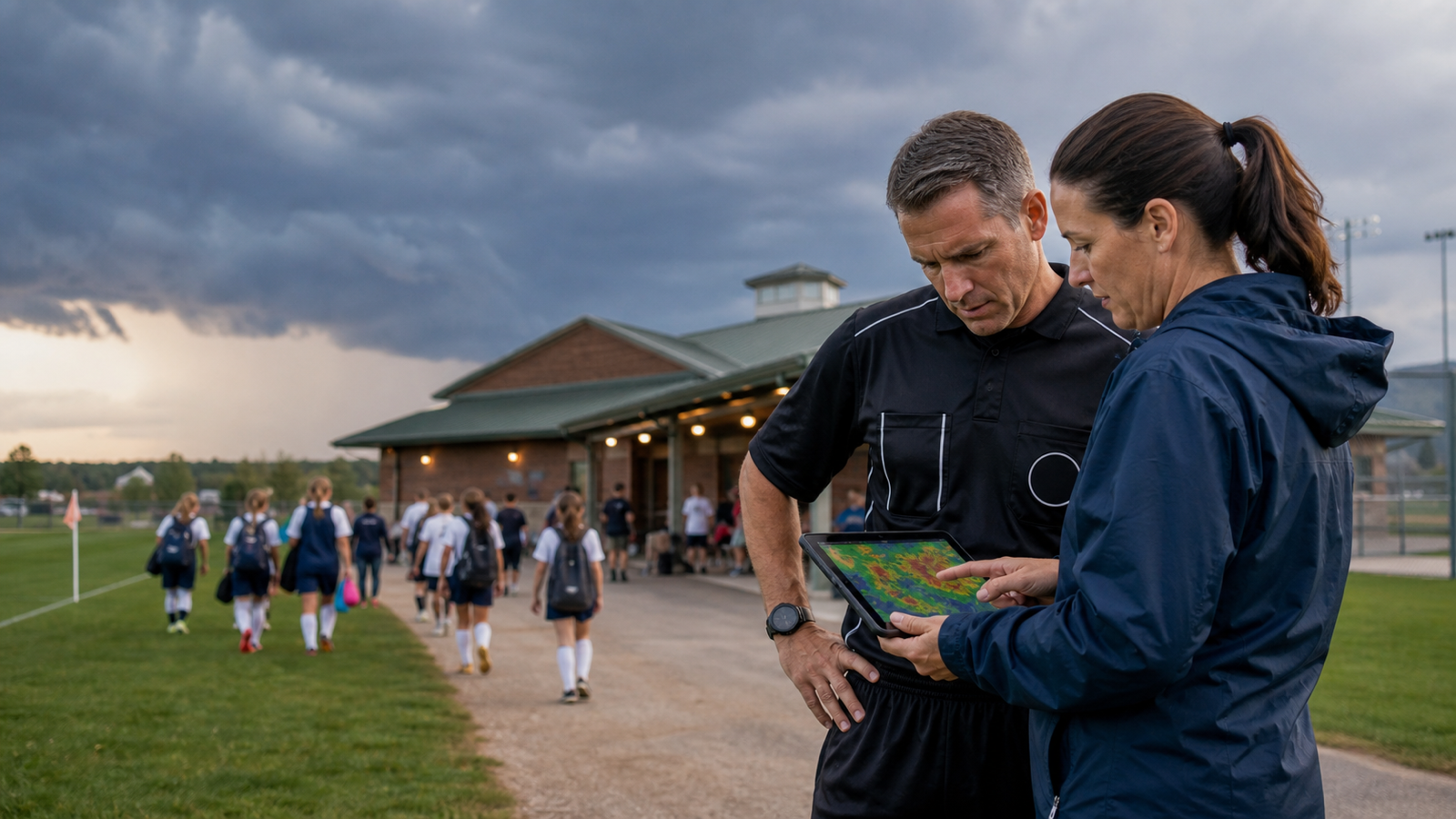
A lightning delay is a safety decision first. It is also an operations test: one storm can change field access, kickoff times, crew availability, family communication, and officials’ pay in minutes. A written plan keeps the referee from carrying all of those decisions alone.
Short answer
Youth sports leagues should name one weather monitor with clear authority, identify genuinely safe shelter at every venue, stop activity under the applicable governing-body policy, restart the 30-minute wait after each new thunder or lightning event, and use one communication channel for the all-clear or cancellation. Before the season, also decide how delayed, shortened, moved, and canceled games affect official assignments and pay.
Why lightning-delay planning is timely now
Fall soccer and football openings are colliding with active late-summer storms. In Google Trends, U.S. search interest for “lightning radar” reached its seven-day peak on August 7, 2026; the related query “current lightning strikes” was marked Breakout. Google Trends is a relative search-interest signal, not a count of sports delays, but it shows that people are actively looking for real-time lightning information as leagues begin preseason and early-season play.
The operational guidance is unusually direct. The National Weather Service says organized outdoor activities should have a lightning safety plan that defines when to stop, where people go, when play resumes, who monitors weather, and what happens if someone is struck. It also says the weather monitor should not be the coach, umpire, or referee, because those people are already occupied.
1. Put one person in charge of weather monitoring
Do not make the game official watch radar, manage teams, interpret league policy, and defend the decision to stop play at the same time. Designate a trained league or venue representative for each game block and give that person unchallengeable authority under the league’s adopted policy.
- Name the primary monitor and a backup before teams arrive.
- Specify the approved forecast, radar, or lightning-detection sources.
- Write down the threshold from your governing body or venue policy.
- Tell officials, coaches, and site staff who announces a suspension and all-clear.
Local rules may assign formal authority differently, so align this workflow with the sport’s governing body, facility agreement, and insurer. Technology informs the decision; it does not replace the adopted safety policy.
2. Map safe shelter by field—not by complex
“Go to shelter” is incomplete if nobody knows which shelter or how long evacuation takes. The National Weather Service identifies substantial buildings as safe options and notes that small outdoor structures such as dugouts, rain shelters, and sheds are not safe. A hard-topped metal vehicle with closed windows can provide protection when a substantial building is unavailable.
- List the primary and backup shelter for every field.
- Time the walk from the farthest playing area.
- Account for spectators, young athletes, mobility needs, and locked doors.
- Post a simple route for visiting teams and officials.
- Cancel or relocate in advance when the venue cannot shelter the expected crowd.
The CDC’s organized sporting-event guidance likewise calls for an evacuation plan, a person monitoring forecasts and reports, and a safe shelter.
3. Make the 30-minute clock visible and reset it correctly
The National Weather Service and CDC advise waiting at least 30 minutes after the last thunder before outdoor activity resumes. NFHS guidance says activity should not resume until 30 minutes after the last thunder or lightning flash. Use the rule that applies to your competition, and record each event that restarts the clock.
- Log the time play stopped and the reason.
- Log every later thunder or lightning observation that resets the count.
- Publish the earliest possible reassessment time, not a promised restart time.
- Issue an all-clear only through the person and channel named in the plan.
Do not let a clearing sky, a coach’s schedule pressure, or an open field on another app substitute for the policy.
4. Decide the schedule tree before the first storm
A safe suspension can still become an administrative mess if nobody knows what comes next. Build a small decision tree for each game window:
- Can the game restart within the facility’s operating window?
- If not, can it be shortened under the competition rules?
- Can later games slide without creating unsafe staffing or travel?
- Which games take priority if field time becomes limited?
- Who decides postponement, cancellation, or rescheduling?
Protect officials from hidden schedule expansion. A referee who accepted a 5:30 p.m. game may not be available for a 7:15 p.m. restart, and moving one game can break the crew plan at another venue. Related: planning makeup games without multiplying the umpire shortage and using game-day check-ins to catch coverage gaps.
5. Send one message that answers five questions
During a delay, every update should state:
- Is play suspended, postponed, or canceled?
- Where should players, spectators, and officials go?
- What is the earliest reassessment time?
- Which game or field does the message cover?
- Where will the next official update appear?
Avoid parallel text chains where coaches, parents, and officials receive different versions. Keep the message factual and do not announce a restart until the authorized all-clear.
6. Set officials’ delay and cancellation rules in advance
Weather policies often explain safety but leave compensation vague. That uncertainty can hurt retention, especially when an official has already traveled, checked in, and held the rest of the evening for the league.
- Define pay when a game is canceled before travel, after arrival, or after play begins.
- Define whether a delayed restart requires the original official to remain.
- State how much schedule movement an official may decline without penalty.
- Separate the attendance record from the final game status so completed work is not lost.
- Explain when a rescheduled game becomes a new assignment.
Publish those rules before assignments are accepted. Related: referee pay transparency and sports official payments software.
7. Debrief every significant delay
After the event, review the operational record rather than debating whether the storm “looked bad enough.” Ask whether the monitor was identified, shelter opened on time, messages agreed, officials’ statuses remained accurate, and pay or rescheduling decisions were completed.
Track recurring weaknesses: fields without real shelter, sites where evacuation takes longer than expected, delayed messages, officials repeatedly stranded between assignments, and canceled games that remain unresolved. Those patterns tell administrators what to fix before the next forecast.
A game-day lightning delay checklist
- Confirm the weather monitor and backup.
- Verify the safe shelter is open and reachable.
- Review the stop and restart rules with officials and site staff.
- Confirm the single communication channel.
- Record suspension and clock-reset times.
- Recheck downstream official and field assignments.
- Apply the published cancellation and pay rules.
- Document the outcome and needed follow-up.
Where Umply fits
Umply publicly supports availability-aware assigning, messaging, real-time schedule updates, conflict controls, and live check-ins. Those capabilities can help administrators keep assignment status and communication together when weather changes the schedule. Umply does not replace a governing body’s lightning policy, professional weather service, or venue safety plan; the league remains responsible for adopting and enforcing those requirements.
Related: Umply for league administrators, referee scheduling software, official check-in software, and Umply Live.
The practical takeaway
A strong lightning plan removes improvisation from the most pressured minutes of game day. Give one person authority, map real shelter, use the correct restart rule, update every affected assignment, and settle pay expectations before the clouds arrive. That protects people first—and prevents one weather delay from turning into a weekend-wide officiating problem.