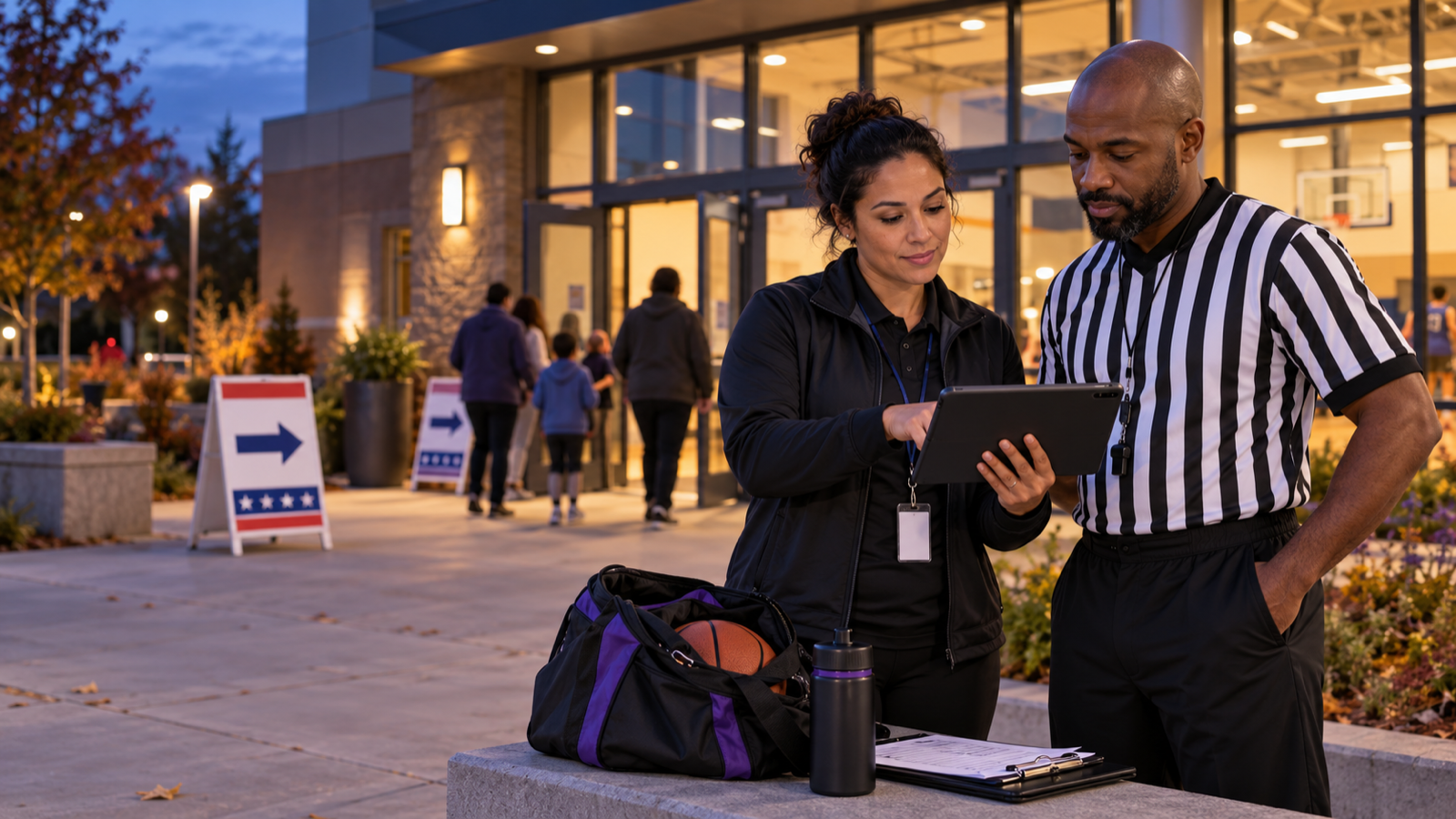
A gym can be available on the league calendar and still be unavailable for sports. Around Election Day, schools, recreation centers, gymnasiums, and even sports stadiums may become voting locations. The conflict can begin before polls open and continue after they close because the site may need time for equipment delivery, setup, security, traffic control, and pickup.
Short answer
For every game, practice, clinic, or officials meeting scheduled from the day before Election Day through the day after it, confirm access directly with the facility owner. Ask about the gym, parking, entrances, storage, security boundaries, and exact hand-back time. If access is uncertain, relocate or reschedule early, rebuild referee travel windows, get fresh assignment acceptances, and publish one authoritative update to officials, teams, and site staff. Do not assume that an open school or recreation center means its court is available.
Why an Election Day facility audit is timely now
Search attention is already moving toward voting logistics. In the current Google Trends comparison for the United States, relative interest in “where do I vote” rose from 28 on October 25 to 75 on November 1. “Polling place” rose from 11 to 31 over the same period. Google Trends values are normalized search interest rather than counts of gym conflicts, but the increase is a useful signal that Election Day logistics are becoming immediate.
The operational connection to youth sports is direct. The U.S. Election Assistance Commission's Election Management Guidelines list community centers, gymnasiums, sports stadiums, and school meeting rooms among potential voting locations. The same guidance says most voting locations receive equipment the day before the election, remain open on Election Day, and store equipment until it is picked up the day after—often a commitment of three or more days.
USAGov confirms that the next midterm elections are in November 2026. Local dates, early-voting arrangements, site rules, and building access vary, so the league should verify each venue with the facility owner and local election authority rather than applying one national assumption.
1. Audit the full facility window
Start with every league activity scheduled at a school, municipal building, recreation center, church, community center, or arena from Monday through Wednesday of election week. Include practices, games, referee training, equipment pickup, and meetings—not only published contests.
For each activity, record:
- the venue, court or field, entrance, parking area, and storage space normally used;
- the facility contact who can authorize sports access;
- whether the building or any adjacent area is a voting location;
- delivery, setup, polling, breakdown, and pickup windows;
- security or traffic restrictions that change normal access; and
- the exact time the space is released back to the league.
A “no school” calendar entry is not a facility confirmation. Neither is a door that happens to be open. Get a direct answer from the organization controlling the space.
2. Ask about shared areas, not only the court
The gym may remain physically untouched while the parking lot, lobby, hallway, restrooms, or accessible entrance is reserved for voters and election workers. A league cannot run a normal arrival pattern if teams and spectators would cross a secured route or occupy required parking.
Ask the facility contact for a simple boundary map or written description. Confirm which doors may be used, where teams may wait, whether spectators are permitted, and whether sports signage, check-in tables, or concessions can be set up. If the event cannot operate without interfering with voting access or facility rules, move it.
3. Rank activities before searching for replacement space
When several activities lose a venue, decide what must be preserved first. A practical order is:
- league or tournament games that are difficult to remake;
- games involving significant official or team travel;
- time-sensitive evaluation, certification, or playoff activity;
- practices that can move to another day or smaller space; and
- meetings that can be held remotely.
Use the same criteria across divisions. A written priority order helps administrators make fast, consistent choices when replacement court time is limited.
4. Rebuild the assignment, not just the address
A venue change can turn an accepted referee assignment into an impossible one. The new gym may be farther from work, school, or a prior game. Parking and building access may add time even when the map distance looks similar.
For every moved contest, recheck the official's arrival requirement, prior and following assignments, realistic drive time, parking instructions, entrance, court location, and required role or qualification. Then request a fresh acceptance. Do not treat the original confirmation as consent to a different time or site.
Keep a short backup list for each moved game. If one official declines, the assigner should be able to contact a qualified replacement without rebuilding the entire day's coverage.
5. Protect Election Day access and neutrality
The league should follow the facility owner's instructions and all applicable local election rules. Keep sports participants outside restricted areas, preserve accessible routes, and do not cover or move official voting signs. Avoid league messaging or apparel displays that could be mistaken for electioneering near a voting location.
Name one site lead who coordinates with the facility contact. Coaches and officials should know whom to call if an entrance is closed, parking changes, or an election worker identifies a conflict. They should not improvise another route through the building.
6. Send one complete schedule update
A chain of partial texts creates multiple versions of the plan. Update the authoritative game record first, then send one message containing:
- the game or activity identifier;
- the original and revised date, time, and venue;
- the new arrival time, entrance, parking, and court;
- the reason for the change in neutral operational language;
- the acknowledgment deadline for officials and team contacts;
- the site lead's contact information; and
- a clear note that copied calendars or earlier messages are superseded.
Send it to officials, coaches, teams, facility staff, and anyone responsible for unlocking, equipment, scoring, or supervision. Avoid sharing voting instructions unless they come from the official election authority; the league's message should stay focused on sports operations.
7. Verify the replacement on game day
Have the site lead reconfirm access before teams travel. Check that the replacement gym is unlocked, the court is playable, equipment is available, and the assigned officials have acknowledged the final details. If the replacement venue is near a voting site, confirm that parking and entrances still match the written plan.
A short check-in window also catches the most common failure: someone driving to the original gym from an old calendar invitation.
Election Day youth sports schedule checklist
- List every league activity from the day before through the day after Election Day.
- Confirm voting-site use and the complete setup-to-pickup window with each facility.
- Check parking, entrances, hallways, restrooms, storage, and accessible routes.
- Rank games and practices before allocating replacement space.
- Update the master schedule before sending messages.
- Recalculate referee travel and arrival windows for every move.
- Get fresh assignment acceptances and name qualified backups.
- Publish one complete update to all affected groups.
- Assign one site lead to coordinate with the facility.
- Reconfirm access and acknowledgments before anyone travels.
Where Umply fits
Umply publicly supports game scheduling, official assignments, conflict and qualification guardrails, messaging, live check-ins, and payment visibility. A league can use those capabilities to revise the game record, rebuild official coverage, communicate the new details, and verify that people are heading to the right site. Umply does not determine whether a building may be used for voting or replace directions from the facility owner, election authority, governing body, or local law.
Related: the daylight saving time schedule reset, game-day official check-ins, assigning software versus spreadsheets, and Umply for league administrators.
The practical takeaway
Election Day facility conflicts are predictable when leagues look beyond the game time. Confirm the full building-use window, treat shared access as part of venue availability, rebuild every affected assignment, and make one schedule the source of truth. That protects voting access while keeping as many youth sports activities as possible on track.